HomeThe Lunar 100 list contains a selection
of the Moon's 100 most interesting regions, craters, basins, mountains, rilles
and domes. For more details on the list, see
http://the-moon.wikispaces.com/Lunar+100
On the 26th February 2007 I took a photo of the moon
Moon 26th February 2007 phase 77%
This page contains crops from this image, magnified them by 1.4x. I have
added them in order of latitude to help locate them in the original image.
|
83
19
23 |
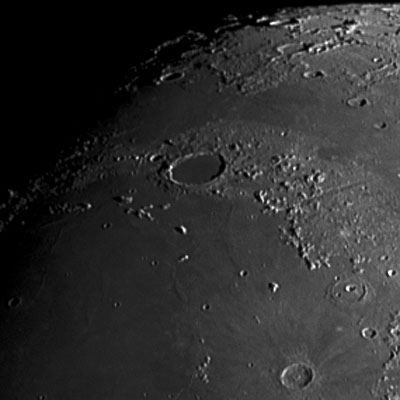 |
L83 Plato craterlets. Plato is the large, dark floored
crater just above centre in this image. It is 60miles in diameter and has
a very smooth flat floor. It contains some tiny craters that are very
difficult to observe. They are not visible in this photo. L19: Alpine Valley. Lunar graben. 80 miles in length.
To the right of Plato.
L23: Mons Pico. In the centre of the image, below the large crater
Plato, is a tall isolated mountain (2500m). In this image it casts a very
long shadow. The isolated mountain below it is Pico B. The third isolated
mountain Mons Piton is to the S.E of Pico.
Also see Lunar 100 68% |
|
5 |
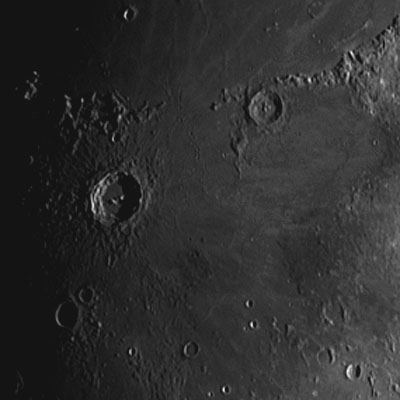 |
L5 Copernicus. The large crater to the left of centre in
this image. One of the most impressive sights on the moon. 56 miles in
diameter. The wall to the west is about 4000m tall. The central mountains
consist of five small peaks. |
|
28
47
75
92 |
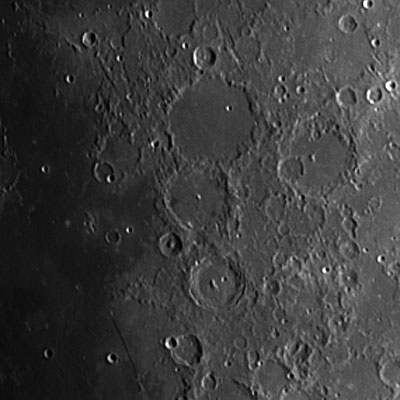 |
L28: Hipparchus is the large crater on the right. It has a peak at the
centre and contains a medium sized crater on it's west side. L47:
Alphonsus. On the left is a chain of three craters. From north to south:
Ptolemaeus, Alphonsus, Arzachel. There are several ash deposits (dark
spots) within Alphonsus (look around the edge). Ejecta from the Imbrium
impact basin has cut troughs in the crater wall.
L75: Ptolemaeus B. The crater inside Ptolemaeus is Ptolemaeus A.
Ptolemaeus B is a saucer like depression to the north of Ptolemaeus A. Not
really visible in this image.
L92 Gylden Valley. This valley was created by the Imbrium impact ejecta.
To the right of the bright crater above Ptolemaeus.
Also see Lunar 100 68% |
|
15
84 |
 |
L15 The straight wall (Rupes Recta). At the upper right of the
image. Best example of a lunar fault. It extends for 65 miles in a nearly
straight line terminating at the S.E. end in a rather peculiar mountain
group. The wall is over 150m tall. Also see
Lunar 100 68% L84 Pitatus.
Crater with concentric rills. Not visible in this image. |
|
6 9 |
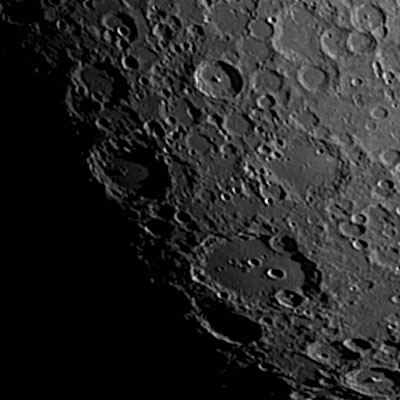 |
L6 Tycho. This is the bright crater the top centre of the
image. The brightest ray system on the moon originates from this crater.
It must therefore be a relatively recent crater (in a lunar time scale!).
It is 54 miles in diameter, the central mountain is 1700m tall. L9
Clavius. This large crater at the bottom centre of this image contains an
arc of size sorted craters at the bottom centre of this image. Clavius is
142 miles in diameter. |
To see Lunar 100 images for the moon phase 22%,
click here
To see Lunar 100 images for the moon phase 36%,
click here
To see Lunar 100 images for the moon phase 47%,
click here
To see Lunar 100 images for the moon phase 58%,
click here
To see Lunar 100 images for the moon phase 68%,
click here
| Date |
26th February 2007 |
| Telescope |
250mm F4.8 Newtonian Reflector with MPCC coma
corrector with 90mm aperture mask |
| Filter |
Red |
| Detector |
CCD using red filter
Stacked best 10 frames from 64.
Exposure 0.2 seconds |
| Software |
IRIS |