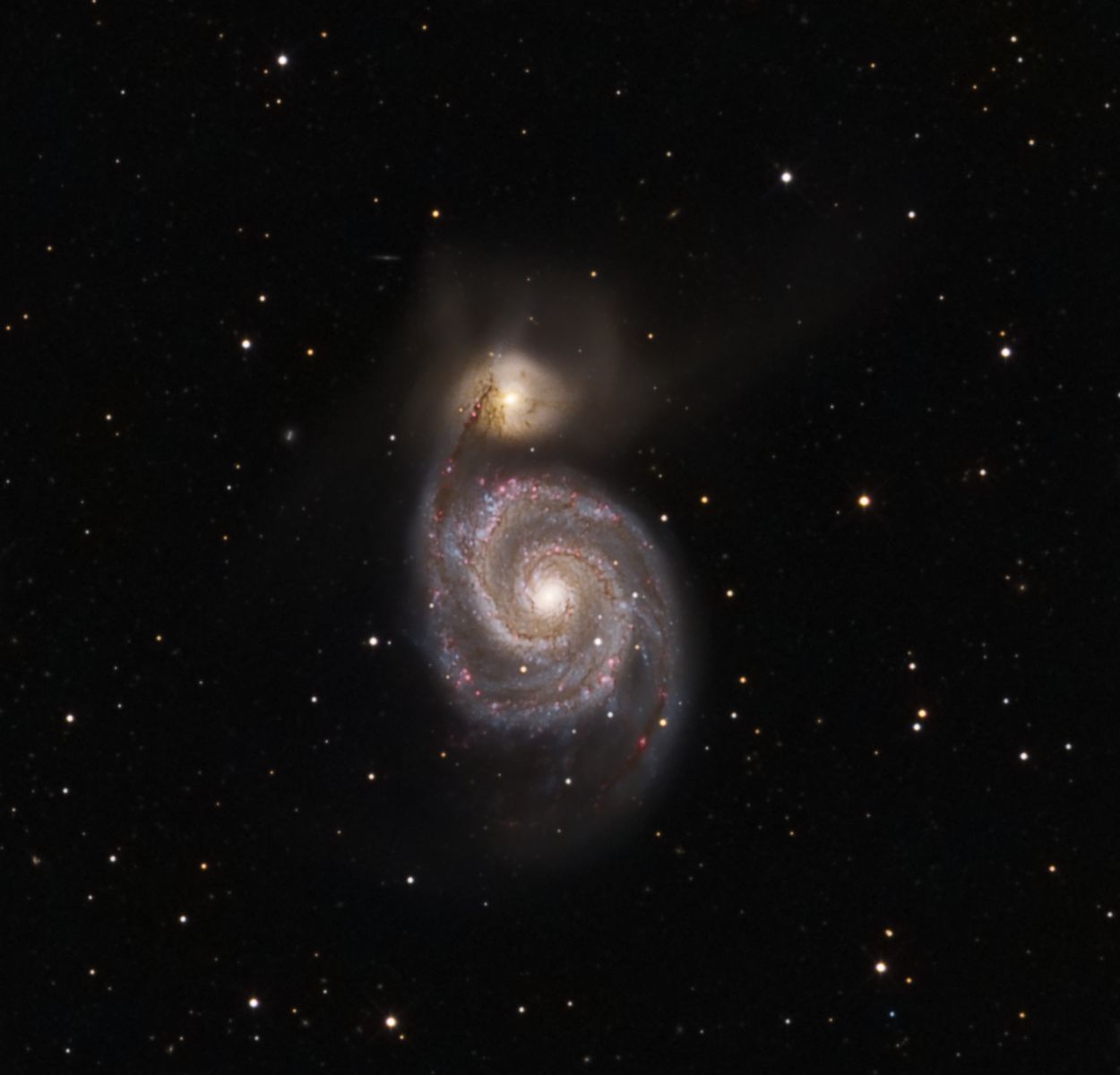
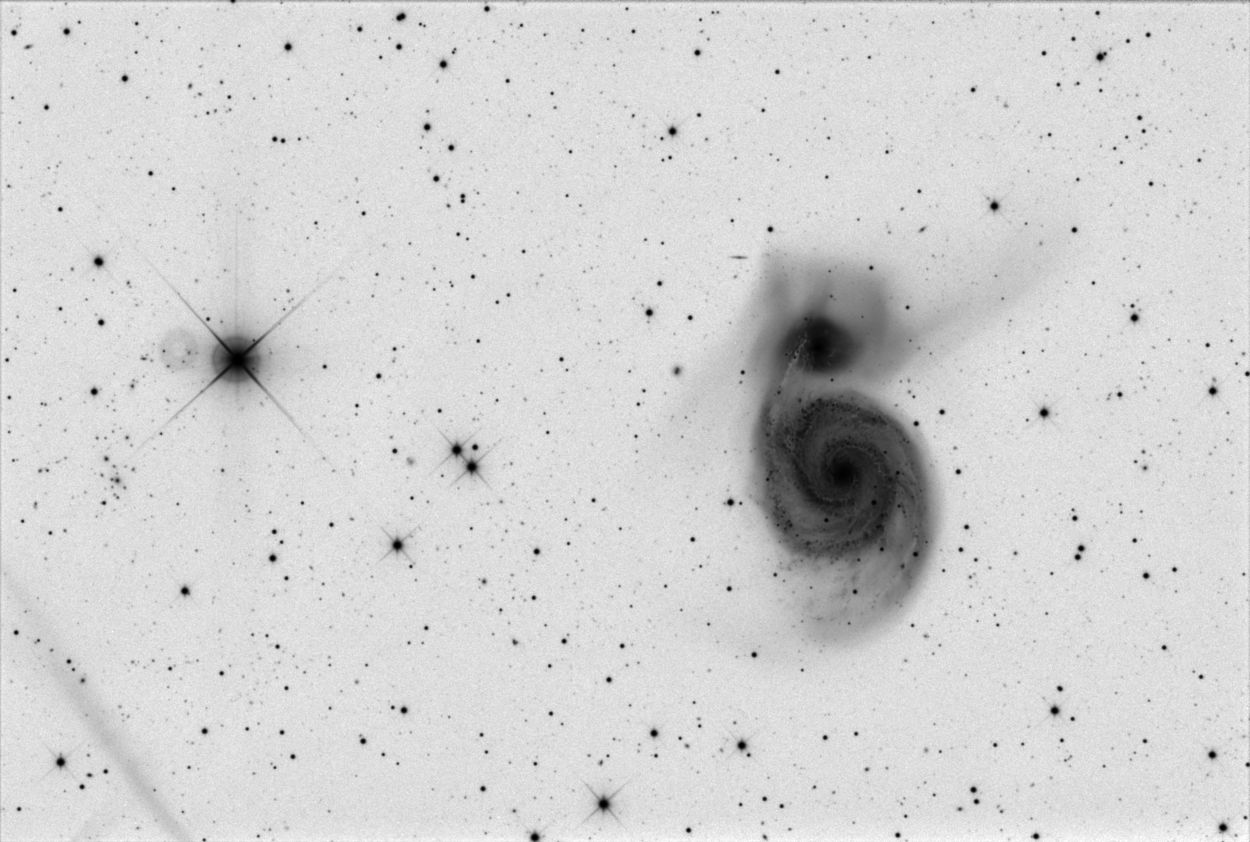
The Whirlpool Galaxy (NGC 5194) is an unbarred spiral galaxy viewed
from a distance of 37 million light years. It has a diameter of
50 thousand light years making it half the size and mass of our own
galaxy. It was the first galaxy observed to have spiral structure.
The companion satellite galaxy (NGC 5195) is a barred spiral. It is
travelling away from us roughly along the line of sight. It is now
behind M51's spiral arm. We know this because the spiral arm's dust
lane is above the companion galaxy. The gravitational tidal interaction
between these two galaxies has made M51's spiral arms more prominent
and it has also heavily distorted the barred spiral.
M51 is a Seyfert galaxy. This means that much of the energy emitted
from the galaxy nucleus is due to a massive black hole at the center.
Any material (stars or gas) that gets too close to this black hole get
ripped apart and accelerated to very high speeds. This process produces
the observed radiation. Of course we can only see the radiation from
material that has not yet fallen within the black hole's event horizon.
Almost all galaxies are thought to have a black hole at their centre
but most are now relatively inactive because they have run out of near
by material. The black hole in the Whirlpool galaxy is more fortunate
because the gravitational disturbance from the companion galaxy is
bringing material within it's reach again.