 M66
Sb Spiral Galaxy M66
Sb Spiral Galaxy
This galaxy has a visual magnitude of 8.9 and has an
apparent size of 8x2.5 arc minutes.
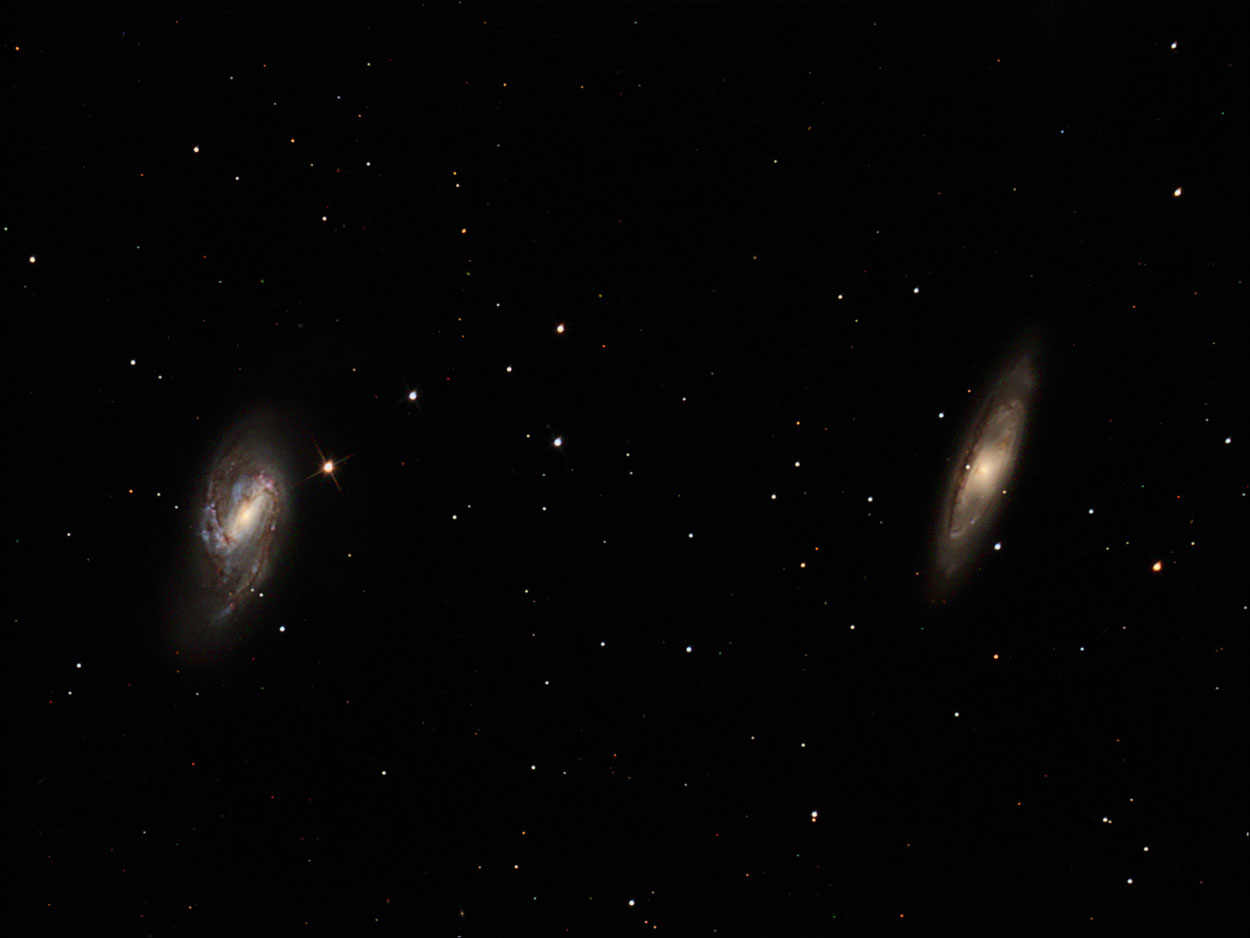
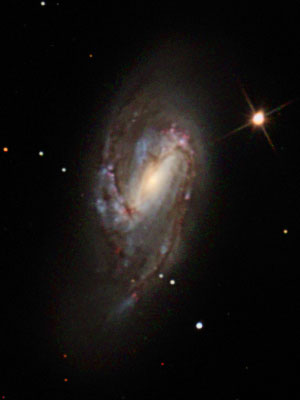
The spiral arms are clearly not symmetrical. They have been distorted
by a close encounter with one of its neighbors. There are significant
kinks in the spiral arm on the right hand side. The first just above
the nucleus and the other half way down the arm on the right hand side.
Prominent dust lanes are visible along with pink emission nebula within the spiral arms
(just like the orion nebula). But why are the spiral arms blue? And why is the nucleus red?
Stars are born with a range of masses. The vast majority will be low
mass stars with masses ranging from 0.1 solar masses (red dwarfs)
up to the mass of the sun. These low mass stars appear red due to their
low surface temperature. The rest of the stars will have masses up to
100 times greater than the sun. These stars have a high surface
temperature during
their hydrogen 'burning' phase (this phase is often referred to
as the 'main sequence'). This high temperature makes them
appear blue.
Stars spend the vast majority of their life burning hydrogen (i.e. on
the main sequence). During this phase their luminosity is proportional
to their mass to the power 4. For example, a 0.1 solar mass red dwarf
will have a light output 0.0001 times that of the sun. A 100
solar mass star will be 100,000,000 times the luminosity of the sun.
Burning so very brightly comes at a cost - the star's hydrogen fuel can
run out very quickly. The length of the hydrogen burning phase is
inversely proportional to the cube of the mass. The 0.1 solar mass red
dwarf lives one thousand times longer than the sun (many times longer
than the current age of the universe). But the super luminous 100 solar
mass blue star will consume all its hydrogen one million times quicker
than the sun. So the low mass red dwarf lives one thousand million
times longer than the high mass blue star!
In a young stellar population, the high mass blue stars are so luminous
they dominate the combined light output. Hence a young population looks
blue. So we know that the blue spiral arms in this galaxy must be full
of young stars. As a stellar population starts to age, all the super
massive stars soon die by exploding (supernova). The lower mass red
stars survive, so the combined light gradually turns red over time. The
nucleus is red because it is full of ancient stars, many of which will
be almost as old as the universe. Of course when the galaxy was young,
the nucleus would have been blue! The
nucleus is partially saturated in this photo which makes it appear less
red than it really is.
|