The
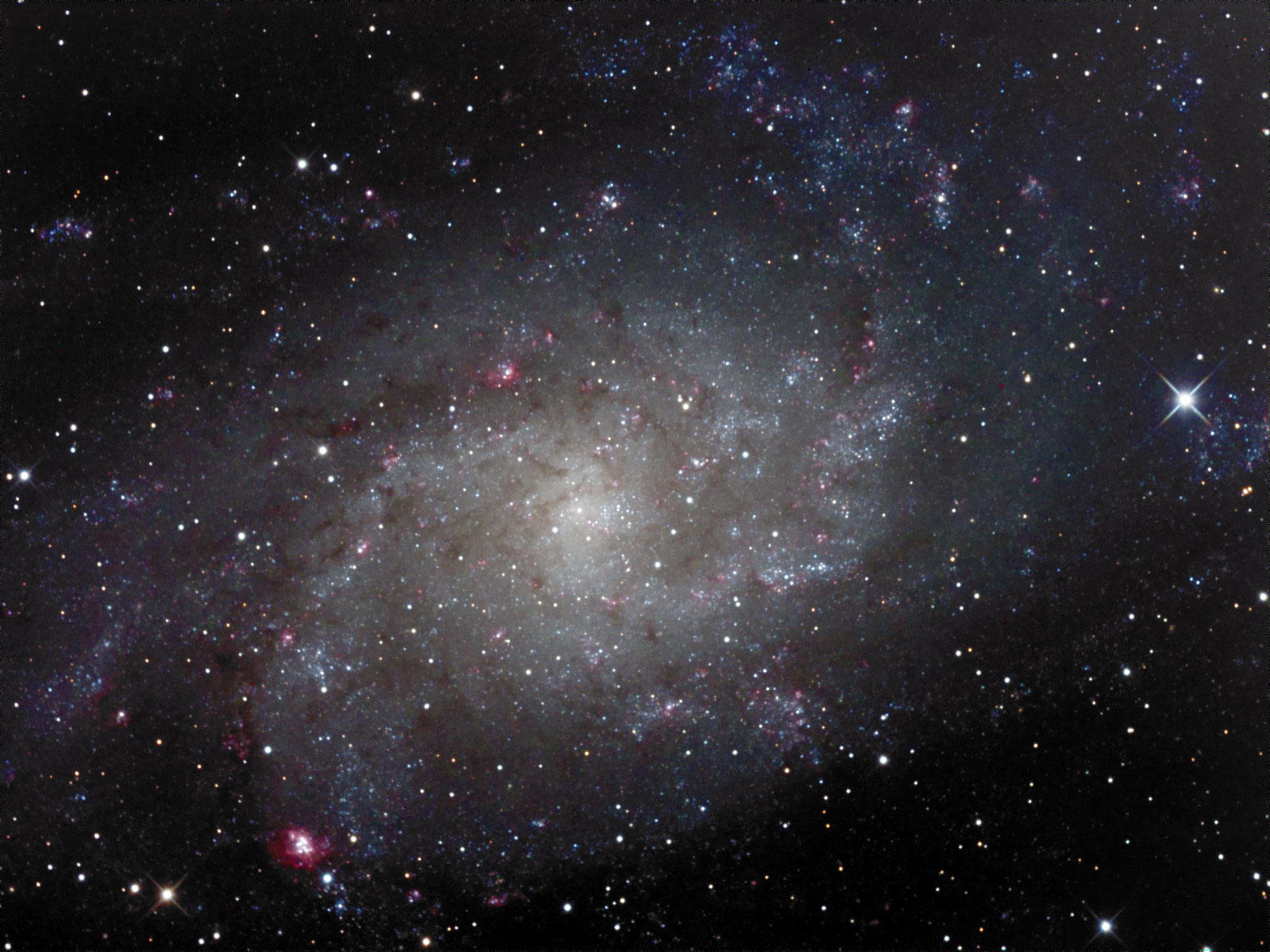
Triangulum galaxy (M33 / NGC 589) is a spiral of type Sc at a
distance of 3.0 million light years. This is an improved estimate
after the Hipparcos satellite survey of Cepheid variable stars in
1997 - the old estimate was 2.3 m.l.y. It is a member of our
local group of galaxies.
Our local group of galaxies contains three galaxies that are
significantly larger than the rest. The largest is the Andromeda
galaxy which contains 1000 million stars. Our own galaxy comes
second with about 200 million stars. The Triangulum galaxy has 25
million stars and is half the diameter of our galaxy. The size of
the Triangulum galaxy is actually about average for spiral
galaxies in the universe. The Triangulum galaxy is
relatively close to the Andromeda galaxy (M31) and may be
gravitationally bound to it. This galaxy is moving towards our
solar system at 180 km/sec and therefore has a blue shift instead
of the more normal red shift. After correcting for the solar
systems orbital speed around our galaxy, M33 is approaching our
galaxy at 24 km/sec.
The spiral arms contain many red HII regions. Indeed, this galaxy
contains one of the largest HII emission nebula ever observed
(NGC 604) with an enormous diameter of 1500 light years. Despite
its size, it is a normal emission nebula - its spectrum is very
similar to that of the Orion Nebula. The HII region contains over
200 massive young stars (15 to 60 solar masses) and it is these
stars that are responsible for illuminating the whole nebula.
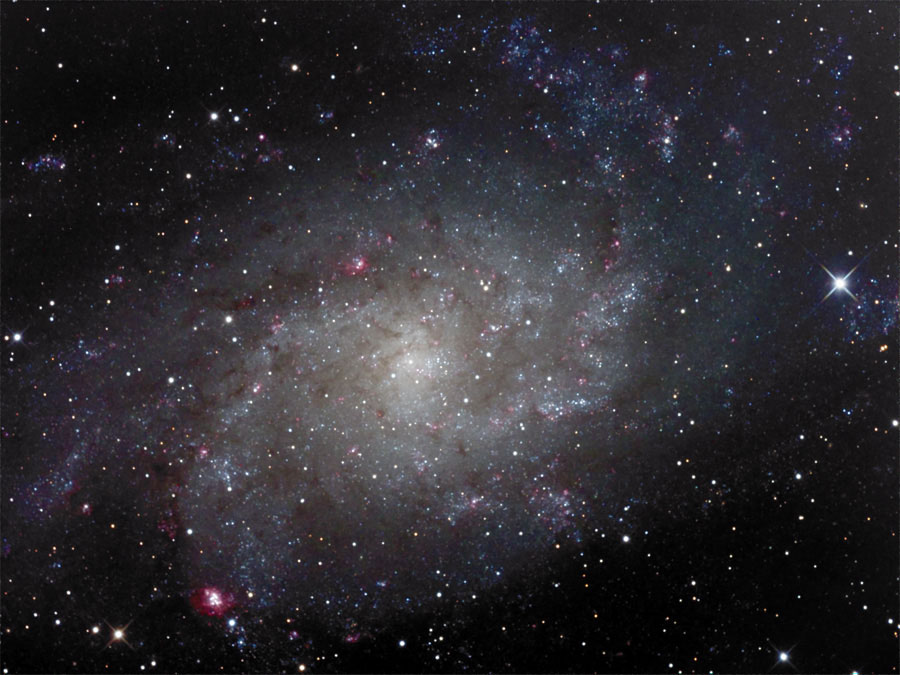
This HII region is visible at the top left of this picture (north
east of the galaxy). Several of the other HII regions are also
visible in this photo.
This galaxy
does not have a massive black hole at it's center. This is
thought to be the case for one in six spiral galaxies.
These galaxies also have a far less prominent central
bulge.
The Triangulum galaxy was one of the first galaxies to be recognized to
be a spiral nebula. It was also one of the first spiral
nebula to be identified as a galaxy after its Cepheid variables were
used to measure its distance.
At magnitude
5.7 this galaxy is probably the most distant object that is
visible to the naked eye. It can be a difficult object to observe
with a telescope because the surface brightness is very low due
to its large size. It's best seen at a magnification of 25x, so a
small telescope actually provides the best views (the ideal
aperture is 175mm). If we could see our own galaxy, its spiral
arms would look very similar to the Triangulum
galaxy.
Date
10th September 2007
Telescope
250mm F4.8 Newtonian Reflector with MPCC coma corrector
Exposure (seconds)
24 x 300s Luminance, 12 x (130s Red, 59s Green, 82s Blue)