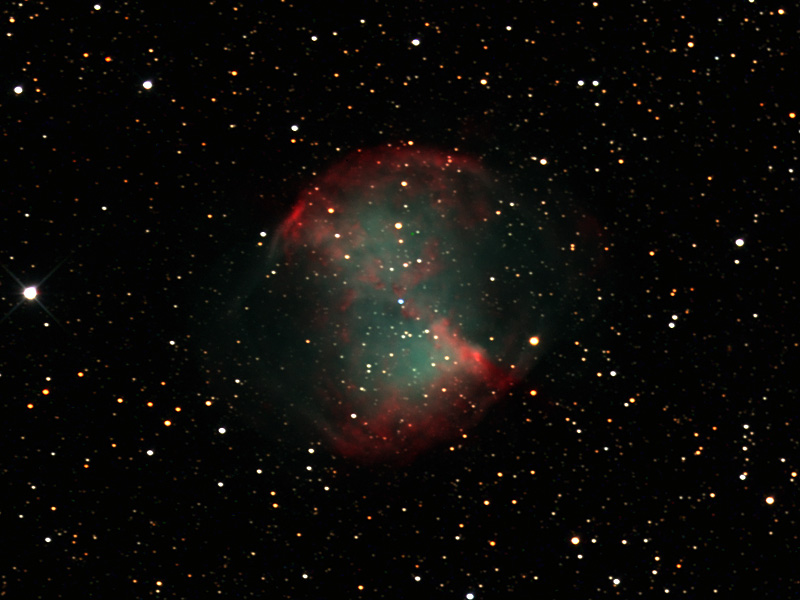
Planetary nebula (NGC6853) within the constellation of Vulpecula. We
are viewing this planetary nebula from its equatorial plane which runs
approximately vertically in this image. If we viewed it from the pole
it would probably look similar to M57, the Ring Nebula.
The central star is a very hot white dwarf, with a surface temperature
of 85000K. It is quite bright (for a planetary nebula) with an
apparent magnitude of 13.5. The nebula is about 275 times
brighter (magnitude 7.4) than the central white dwarf. This might seem
surprising at first since the nebula glows by absorbing ultra violet
light from the white dwarf and then re emitting it - mostly in the
Hydrogen alpha and Oxygen [III] emission lines. The reason of course is
that the star emits most of its radiation in the ultra violet due to
it's high surface temperature.
The Mira type variable Star...
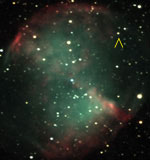
The star arrowed is a Mira type variable star with a magnitude range
from about 13.5 to 18.5 with a period of approximately 213 days. Mira
variables are very cool red super giants and their luminosity variation
is due to extremely large pulsations. In this photo the star must be
close to maximum. At minimum it is absent from most photos. See www.seds.org/messier/xtra/leos/gl.html for more information.
Date
29th June 2006 (L), 30th June 2006 (RGB)
Telescope
250mm F4.8 Newtonian Reflector with coma corrector
Exposure (seconds)
12 x 300s Luminance
20 x 120s Red, 10 x 120s Green, 10 x 120s Blue